 Theme: Passenger and Express

The goal of the Element Track Plans are to create a portion of a scene (such as a small business or activity) that can be inserted into a layout to instantly expand Operating interest. Perfect for Freelancers or "Tinplaters", they use a minimal number of turnouts, and can often be populated with toy structures. The track plans and structure styles in each element differ slightly, for visual variety should multiple elements be added to your layout.
The following spur represents a setout track at a large town station, that allows sleeping car passengers to board early or depart late (typically for trains that pass through in the wee hours of the morning).
The following spurs represent an express depot with optional driveway unloading, that can handle full-length "baggage cars" without disturbing each other.
The following spur represents a business that requires high-speed delivery of extremely perishable product (cut flowers).
These Layout Track Plans were conceived as self-contained permanent layouts to fit in a typical name-sized room. Some are continuous run, while others are "vignettes". All could be traditionally wired, and many could be built from permanent modules. Most are shelf style, but even the island style layouts have their track easy enough to reach that they do not require any popup hatches.
This
Note: Traffic was intended to move in a clockwise direction. Opposite direction running is possible though if you use the ovals as runarounds.

This
Although comfortably operable by one person in "sequential" mode, this track plan shines with the addition of a second person to handle the fiddleable staging. To enhance
Note 1: For occasional railfanning, it is possible to make a continuous loop by connecting the end of the Staging tail track to end of the furthest Passenger Yard track. The curve passes through the tall Newspaper building [EXAMPLE].
- If you make this continuous run modification, I suggest you swap the newly connected yard track with the "tail" track, and also make the "engine pullup" be on the other curved turnout.
Note 2: Although this smaller station is designed as a terminus, with the deletion of the Freight House the track plan could be modified so that the station can accommodate through traffic [EXAMPLE].
Most track plans found in books are designed for HO, and they almost always use
The original track plan was 4'x8', which would require a 8'x16' table if exactly upscaled to O-scale. Because accessing the inside of the layout would be too far of a reach at that size, and because O-scale 3rail trains can negotiate tighter curves than HO trains, I compressed the track plan to fit a more S-scale sized 5.5'x13.25' table. It is possible to shorten the table length by a further 10" (on the Hazleton side) if your are willing to reduced spur lengths slightly. There must be an access isle way along both of the tables long sides, but the short Hazleton side can butt against a wall, and the Alesburg side can have its corners rounded off.
While not an exact clone (there are no mesas, the Skillman station was relocated a few inches, and the
This linear
Note: Being a layout with a double tracked main line, this layout could potentially be modified into a continuous run "dogbone" 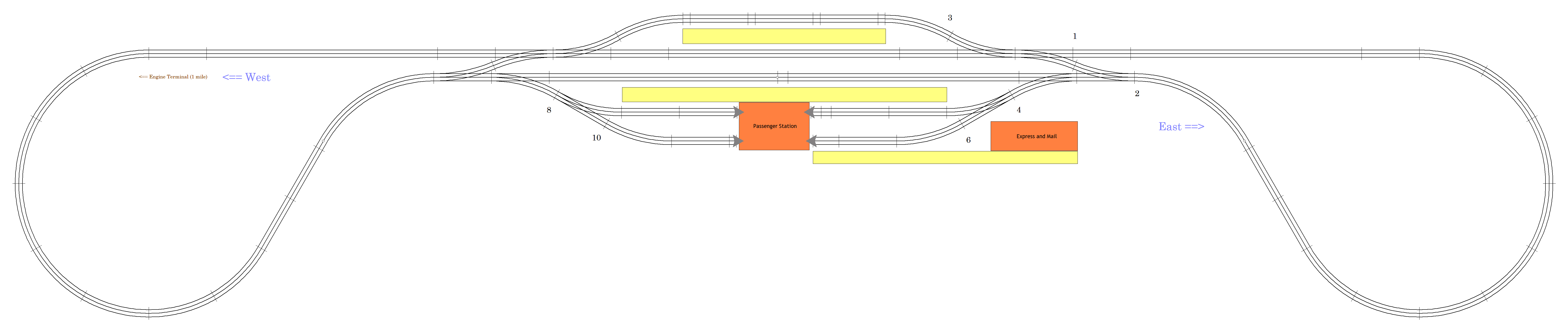
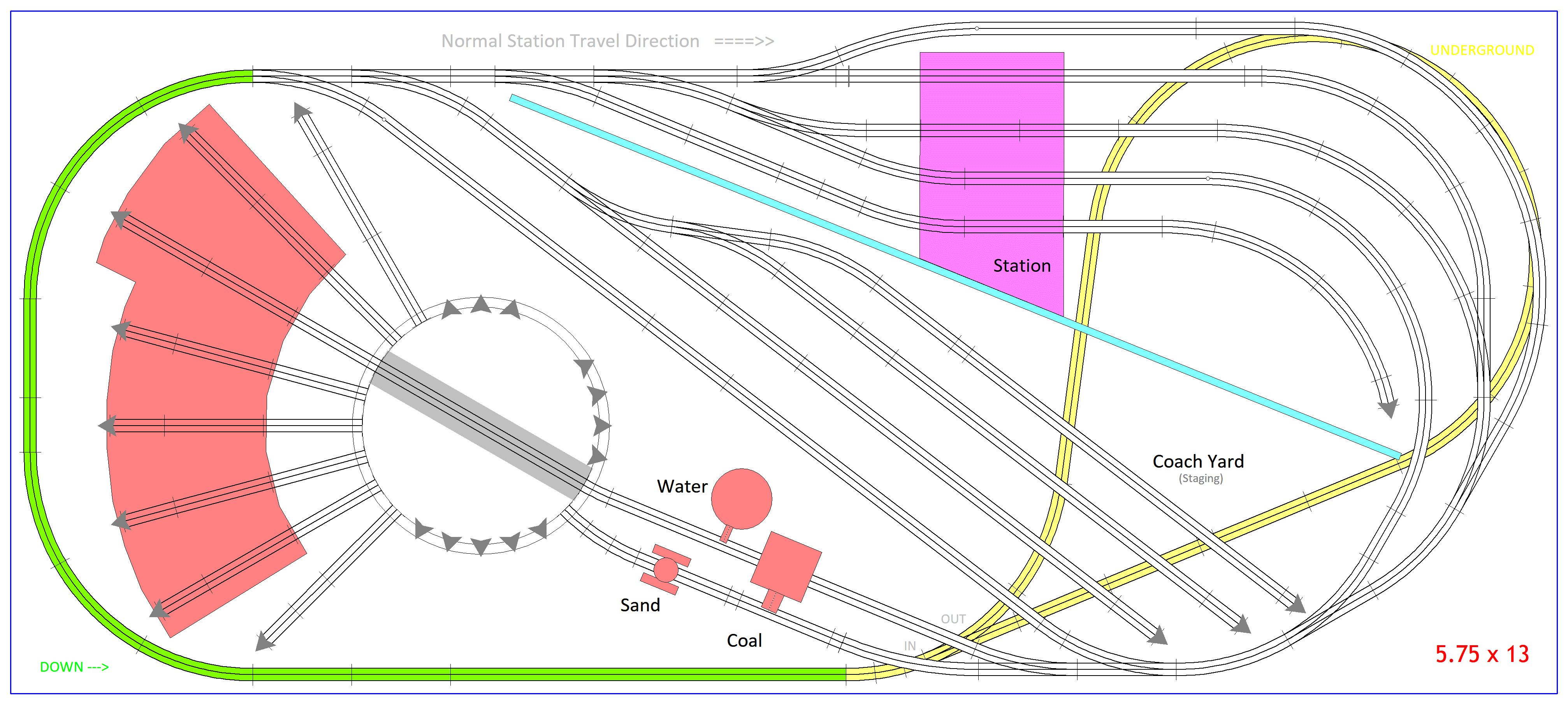
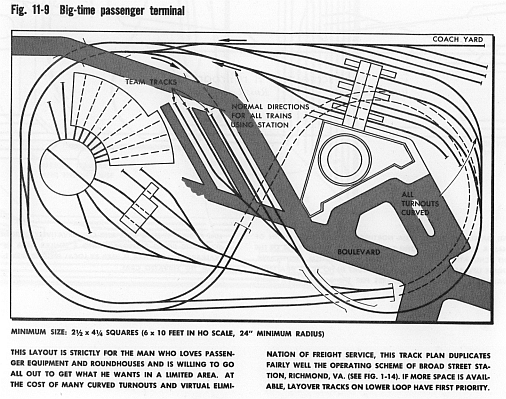
Some track plans, in order to keep the layout to a reasonable size, employ curved turnouts. I chose an island table, loop-to-loop curved turnout steam engine passenger layout featured in the book
As this track plan was designed for HO scale it had to be upscaled, but at the same time I also desired to keep the layout as absolutely small as possible (you can always expand a small layout if you have the space, but the opposite is never true). I also needed to make sure that all portions of the layout remained within a three foot reach.
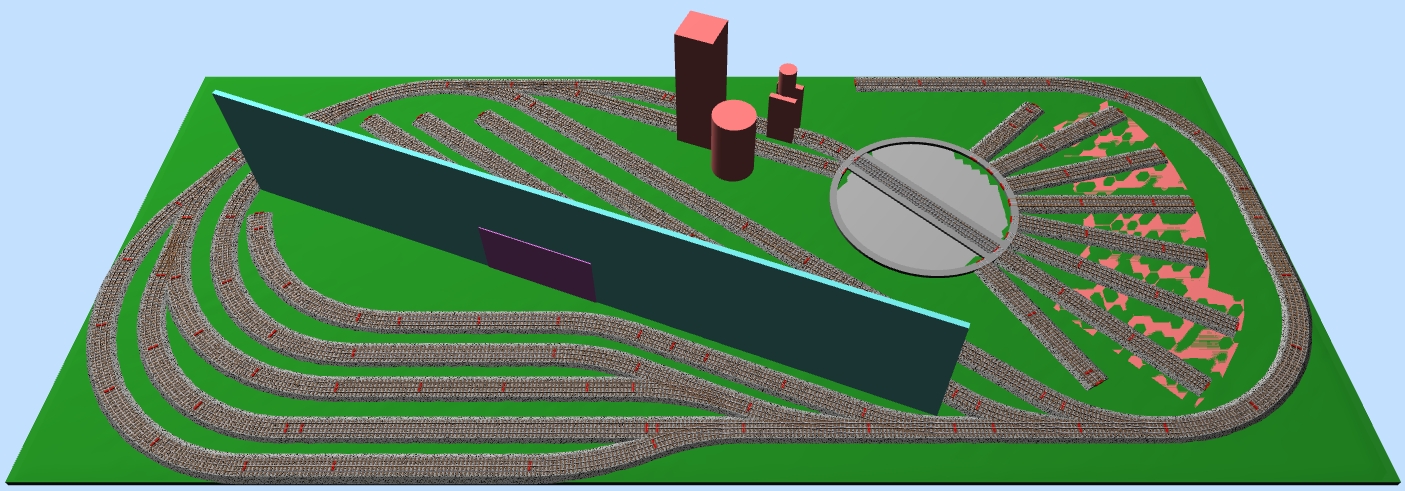
To achieve my goal I had to eliminate some features in the reference layout. The main line was reduce from double track to single track. The vestigial freight spurs (the team tracks and engine terminal supply tracks) all had to be eliminated, but this actually was a benefit as it concentrated the focus on this being a big-time passenger terminal. One coach yard track, One station spur track, One long, short, and outdoor turntable spur, and One turntable lead track had to be eliminated for space reasons, but the advantage is that their expensive turnouts would not have to be purchased. The reach problem was resolved by relocating the coach yard to the inside of the layout, rather than along the outside. As the original plan is a layout of its era, there were no scenic dividers or staging tracks (what they used to call "layover tracks") drawn, but the Coach Yard is very effective to use as pseudo staging tracks. The connection to the engine service area also had to be shifted from the return loop to the station loop, but as a side effect this improved operations.
While not an exact clone of the original track plan (it unexpectedly is even narrower in width than the HO original), this layout design is functionally identical, and fully retains the "feel" of the original. Track in GREEN is an exposed downward grade, and track in YELLOW is hidden beneath the layout. Although a small layout, it justifiably provides
All content appearing on this webpage is FREE for personal use,
being either expressly created or previously posted as anonymously accessible public on the Internet.
No - Signups, Carts, Tracking, Cookies, or JavaScript







![[EXAMPLE]](5/Substitution.gif)
![[EXAMPLE]](5/Continuous.gif)
![[EXAMPLE]](5/Passthrough.gif)